
VECTOKEN INTELLIGENCE FOUNDATION
VIF: the shared foundation for every Vectoken product
VIF is the shared infrastructure on which Vectoken builds and operates production-grade AI products. Industrial and enterprise products reuse connections, knowledge and evidence, work nodes, models and tools, quality governance and continuous evolution, then enter customer environments through product assembly and professional adaptation.
ONE FOUNDATION, EVERY PRODUCT
Build product capabilities on a shared foundation
Industrial and enterprise products have defined functions, domain workflows and interfaces, all built on VIF. The foundation maintains shared components, established work nodes and specialized capabilities. Products select and combine them, while customer deployment adapts data, knowledge and workflows.
VIF ARCHITECTURE
Vectoken Intelligence Foundation architecture
Five engineering layers connect products, work nodes, intelligence, specialized training and data. Roles on the left define responsibilities and access; the evolution engine on the right drives upgrades; security and governance span every layer. Expand a module for its responsibilities and role in product assembly.
Business outputs
- AI queries / Reports / Plans
- Alerts / Risk notifications
- Work orders / Task dispatch
- Approval / Decision support
- Data archiving / Audit
- Enterprise memory
Product applications & workflows
Industrial AI productsEquipment health / AI-SOP / Safety / Quality & efficiency
Maintain product functions, domain workflows and interfaces for equipment, processes, safety and operations. Select modules for the product scope and reuse VIF and established nodes.
Enterprise AI productsAudit / Knowledge / HireRadar / Business collaboration
Recruiting, audit, knowledge and teaching products organize documents, decisions and actions on VIF, sharing evidence, access, quality and version capabilities.
Product composition & extensionReuse Work Nodes / Configure applications / Extend
Combine mature product modules and work nodes with domain rules and customer workflows. Validated shared capabilities become reusable assets and future product versions.
Work-node orchestration
Work Node OrchestratorTask decomposition / Inputs & outputs / Human–AI collaboration
Reuse, configure and orchestrate established nodes around goals and workflows. Define structured inputs and outputs, states, dependencies, timeouts, retries and handoff conditions. Shared contracts support composition, testing and upgrades.
Workflow & ActionAlerts / Work orders / Approvals / System actions
Turn node outputs into alerts, tasks, approvals or authorized system actions. Record execution states and receipts, and handle retries and recovery.
Human-in-the-loopReview / Handoff / Stop conditions / Accountability
Build expert review, approval, handoff and stop conditions into workflows, with clear owners and action permissions. Retain human corrections as traceable feedback.
Intelligence engineering & models
Context & EvidenceContext / Domain semantics / Evidence chains
Organize the task’s business objects, domain context, current knowledge and evidence citations. Retain sources, versions and missing information so decisions can be checked against their basis.
Artifact GraphData / Tasks / Outputs / Version relationships
Register provenance and dependencies across data, models, tasks, outputs and releases. Identify which products and versions use an asset and what an upgrade affects.
Model & Tool RouterModels / Algorithms / Rules / Tool routing
Select models, algorithms, rules and tools for each node’s task, quality, latency and cost requirements: deterministic calculations for amounts, solvers for scheduling, and specialized capabilities for vision and time series.
Quality Gate & Audit MemoryQuality gates / Audit trails / Enterprise memory
Check data, models, configurations, workflows and releases against quality criteria. Preserve evidence, processing versions, outputs, human changes, approvals and actions for review and traceability.
Specialized model training & tools
Dedicated Model TrainingData / Annotation / Fine-tuning / Specialized small models
Prepare training and evaluation data for critical work nodes. Fine-tune or train specialized vision, action, time-series and small models as needed, and register evaluated capabilities as versioned assets.
Tooling LayerAlgorithms / Rules / APIs / RPA / Simulation
Package deterministic calculations, domain rules, solvers and system tools with consistent inputs, outputs and permissions for verifiable computation and execution within work nodes.
Capability RegistryModel cards / Rule libraries / Tool libraries / Evaluation sets
Register versions, purposes, dependencies, evaluation results and owners of callable capabilities. Select suitable model, rule, tool and evaluation assets during product assembly.
Data & knowledge connections
Physical-world dataEquipment / PLC / Sensor / Camera / Edge
Connect equipment, sensors, cameras and edge resources. Establish sampling points, operating conditions, times and object identifiers, turning site signals into usable node inputs.
Digital-world dataDocuments / Tables / Knowledge / OA / ERP / CRM
Organize documents, tables and knowledge with cleaning, structure, knowledge preparation and RAG. Retain current versions, citation locations and access scope.
Business-system connectionsMES / EAP / FDC / QMS / CMMS / BI
Reuse APIs, database views, files and messages. Align objects, fields, incremental updates and recovery rules to connect work nodes with existing business systems.
Data assets: Collect → Align → Clean → Annotate → Publish versioned assets
Security & governance across every layer
Access control / Data security / Audit trails / Version management / Backup & recovery / SLA & operations
View the original PPT architecture
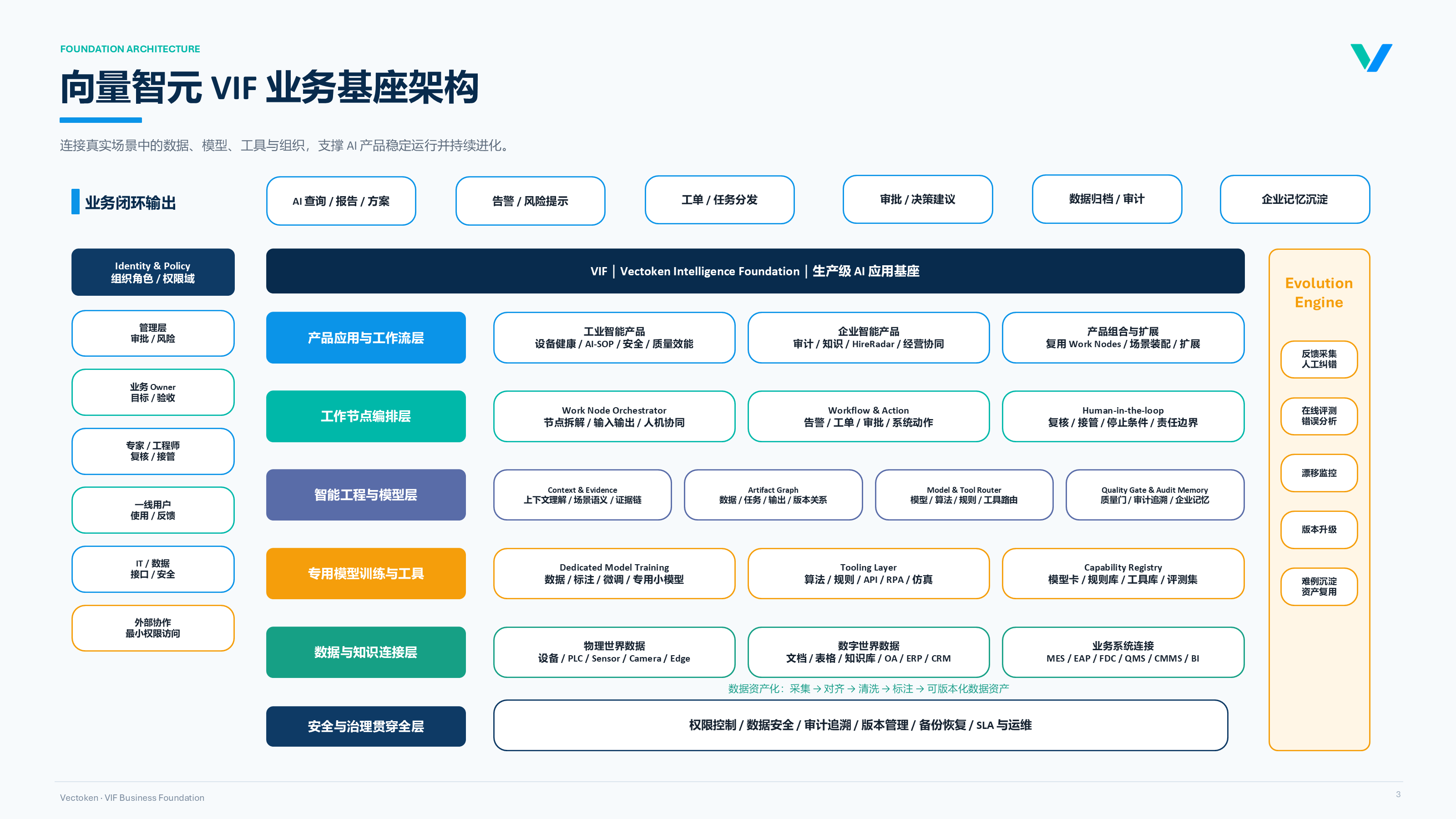 Enlarge full architecture ↗
REUSABLE WORK NODES
Compose complete product capabilities from established work nodes
A Work Node is a business execution unit with a defined goal, inputs, outputs, specialized capabilities and quality criteria. Nodes can use models, algorithms, rules, tools or domain experts, with shared contracts for configuration, orchestration, evaluation and upgrades.
Inputs
Data, documents, site signals and user intent.
Evidence
Sources, versions, confidence and missing information.
Intelligence
Models, rules, algorithms, tools and domain experts.
Actions
Structured outputs, tasks, approvals and system calls.
Handoff
Risk boundaries, human responsibility, stop conditions and recovery.
Evaluation
Samples, metrics, outcomes and rollback thresholds.
NODES INTO PRODUCTS
A shared node system for different professional tasks
Procedure compliance organizes actions, sequences and work evidence. Intelligent audit organizes documents, checks and professional review. Both reuse node contracts, access, evidence and version mechanisms while combining intelligence suited to their tasks.
AI-SOP
- Configure SOP
- Link video and work orders
- Check actions and order
- Retain anomaly clips
- Shift confirmation
- Review and job training
Intelligent audit
- Receive and organize documents
- Plan missing evidence
- Extract candidates and retrieve evidence
- Independent review and cross-checks
- Generate workpapers and report
- Professional review and delivery
PRODUCT ASSETS & RELEASES
Reusable, versioned assets from foundation to product
Product functions, shared components and customer configurations have defined maintenance boundaries and enter the operating environment through one release manifest.
Product version
Business functions, standard modules and interfaces.
VIF version
Shared components, work nodes and interface contracts.
Domain package
Domain rules, SOPs and professional templates.
Data & knowledge assets
Datasets, knowledge bases, annotations and evaluation sets.
Model & tool versions
Model cards, rules, algorithms and tool dependencies.
Customer configuration
Organization, thresholds, workflows, interfaces and environment.
A release manifest binds the assembly into a running product version
Product, VIF, domain, data, knowledge, model, tool and customer configuration assets have separate versions, bound together at release. Upgrades identify affected products, nodes and configurations, run regression checks and retain rollback paths. Shared capabilities remain reusable, while customer materials follow their permissions and scope.
EVOLUTION ENGINE
Return experience to the foundation and keep products evolving
The evolution engine turns feedback into improvements to data, knowledge, rules, models and nodes. Expert review, evaluation and versioned releases return reusable capabilities to the foundation and products, with upgrades applied to the relevant customer scope.
- 01
Real feedback
Failures, corrections and business outcomes
- 02
Data assets
Cleaning, annotation, difficult cases and evaluation sets
- 03
Training & optimization
Knowledge, fine-tuning, small models and rules
- 04
Regression evaluation
Accuracy, stability, safety and cost
- 05
Controlled rollout
Approval, versions, monitoring and rollback
CAPABILITY INDEX
Six capabilities within the same architecture
Connections, assets, intelligence, work, governance and evolution summarize the five engineering layers and the mechanisms that span them.
- Connect
- Context & Assets
- Intelligence
- Work & Action
- Quality & Governance
- Evolution
PRODUCT ASSEMBLY ON VIF
Start with a mature product and assemble it on VIF
Start with a mature product. Reuse, configure and orchestrate established work nodes on VIF, and assemble them with your data, knowledge, models, domain rules and system interfaces. Acceptance, activation, ongoing operation and versioned upgrades keep the product evolving with your business.
VIFShared infrastructure throughout assembly, operation and upgrades
- 01
Mature products & nodes
Choose a standard product, validated modules and established Work Nodes for the agreed scope.
- 02
Customer environment
Connect data and systems; configure knowledge, domain rules, model routing, workflows and human collaboration.
- 03
Customer product release
Bind product, VIF, node, model and configuration versions; accept, activate, operate and upgrade.